
Time: 15 Minutes | Yield: 4 Servings
The landscape of home-cooked comfort has undergone a radical transformation in early 2026. As we prioritize metabolic efficiency and physical resilience, we are moving away from the “all-day simmer” that often results in over-processed, nutrient-depleted vegetables. Instead, we are embracing “Legume-Density”—a culinary strategy that focuses on the rapid mechanical release of starches to create a thick, savory “Protein-Anchor” in minutes. At your site, we believe that your dinner should be a “functional reset”—a meal designed to provide a dense hit of iron and fiber in the time it takes to review your daily wellness metrics.
This 15-Minute One-Pot Vegan Chili is the definitive expression of this high-efficiency trend. It belongs on your One-Pot & Sheet Pan Dinners board because it challenges the traditional “low and slow” bottleneck. By utilizing the “Maillard-Flash” method for the aromatics and the “Starch-Bond” technique for the texture, you achieve a level of flavor saturation that supports your high-performance lifestyle, keeping your energy levels in a state of “Fluid-Flow.”
The Science of “Legume-Density” Efficiency
How do we achieve a restaurant-grade, thick chili in fifteen minutes using only one pot? It comes down to thermal surface-tension and the Starch-Lock rule:
- The Maillard-Flash Bloom: We start by searing the onions, peppers, and spices over high heat in a dry-bottomed pot. In 2026, we utilize this “Flash” to trigger the Maillard reaction almost instantly, creating a savory, “Umami-Locked” foundation that replicates the depth of a long simmer.
- The Mechanical Starch-Bond: We add the canned beans directly to the pan. By mashing roughly 20% of the beans with the back of a spoon, we release their internal starches. This is the Legume-Density moment—the starches act as a natural thickener, binding the tomato base into a glossy lacquer that “grips” the whole beans.
- The Acid-Flash Reset: We finish with fresh lime juice. The citric acid reacts with the heavy chili spices to “lift” the flavor profile, ensuring the meal feels vibrant and restorative rather than heavy and lethargic.
Why This Chili is a 2026 Nutritional Powerhouse
We focus on “Satisfying Strength”—the idea that our quick meals should provide the structural building blocks for physical resilience and sustained cognitive focus.
- High-Density Legume Protein: The combination of black beans and kidney beans provides a complete amino-acid profile. In 2026, we view these as “Performance-Fuel” that supports oxygen transport and muscle maintenance throughout the evening.
- Lycopene and Anthocyanin Shield: The fire-roasted tomato base and dark bean pigments provide a massive dose of antioxidants. These support cardiovascular health and provide a natural “bio-shield” during the spring seasonal transition.
- Fiber-Rich Metabolic Speed: The high fiber content triggers early satiety signals in the brain. This ensures you feel “full and focused” without the “after-dinner crash” often associated with heavy, starch-laden comfort foods.
- Bioavailable Mineral Density: The combination of Vitamin C from the “Acid-Flash” and the iron-rich beans ensures maximum mineral absorption, supporting your physical resilience during a demanding work week.
Ingredients & Substitutions Guide
- 1 Can (15 oz) Black Beans: Drained and rinsed (The “Protein-Anchor”).
- 1 Can (15 oz) Kidney Beans: Drained and rinsed for “Structural-Snap.”
- 1 Can (14.5 oz) Fire-Roasted Diced Tomatoes: For the savory “Umami-Anchor.”
- 1 Cup Frozen Corn: For a sweet “Structural-Pop.”
- 1 Small Onion & 1 Bell Pepper: Diced for the “Aromatic-Flash.”
- 2 tbsp Chili Powder & 1 tsp Cumin: The “Golden-Shield” foundation.
- 1 Cup Vegetable Broth: Keep it hot for the fastest results.
- 1 tbsp Fresh Lime Juice: The essential Acid-Flash reset.
- Fresh Cilantro: For the “Living Layer” garnish.
- Salt & Black Pepper: To taste.
Step-by-Step Instructions
- The Maillard-Flash (Step 1 of 5): Heat a teaspoon of oil in a large pot over high heat. Add the diced onion and bell pepper. Sauté for 3 minutes until the edges are golden-brown and fragrant.
- The Aromatic Bloom (Step 2 of 5): Stir in the chili powder and cumin. Sauté for 60 seconds. This “blooms” the fat-soluble oils in the spices, creating a concentrated foundation.
- The Starch-Bond Build (Step 3 of 5): Add the fire-roasted tomatoes, vegetable broth, beans, and corn. Use the back of your spoon to mash a small portion of the beans against the side of the pot to release the starches.
- The Thermal-Saturation (Step 4 of 5): Bring the mixture to a rapid boil, then reduce the heat to medium. Simmer uncovered for 8–10 minutes. The liquid will reduce and thicken into a glossy, “Legume-Dense” lacquer.
- The Final Acid-Flash (Step 5 of 5): Turn off the heat. Stir in the fresh lime juice and season generously with sea salt and cracked black pepper. Garnish with fresh cilantro.
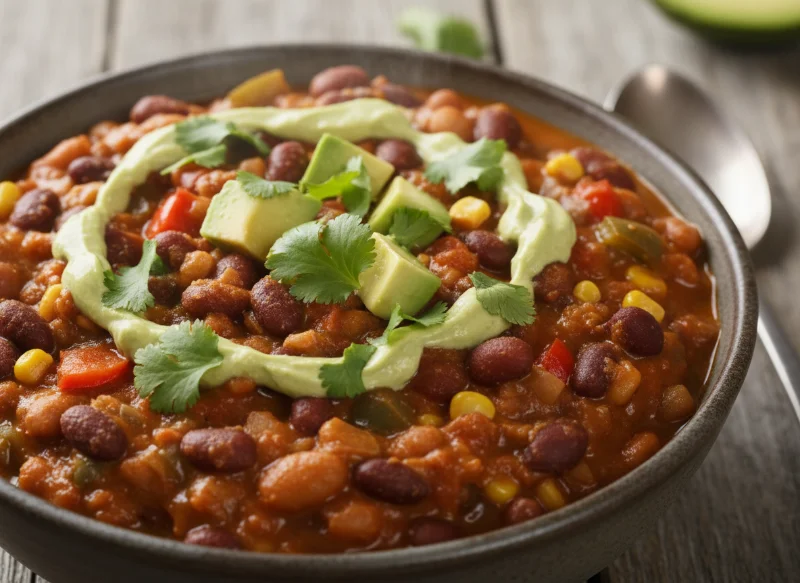
Serve: Divide into bowls and top with avocado or vegan yogurt. Serve immediately while the “Starch-Bond” is at its peak silkiness!
Expert Tips for Success
The key to a restaurant-quality finish is Moisture Management. If the chili looks too “tight” (thick) before serving, add an extra splash of warm water to restore the glossy emulsion. Always use fresh lime juice; the bottled versions lack the volatile oils necessary for a true Acid-Flash. For a high-performance boost, serve this chili over a bed of quinoa or cauliflower rice to add another layer of “Structural-Snap” to your meal.


